


 FSX Other Aircraft & Vehicles
Grumman Tracker S-2F Firebomber
Grumman Tracker S2F Firebomber with dual monitor panel. A complete update of …
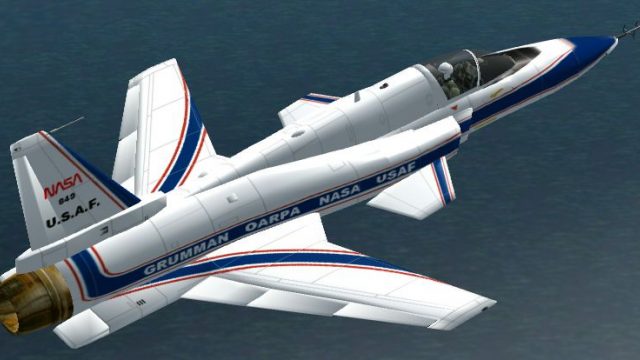
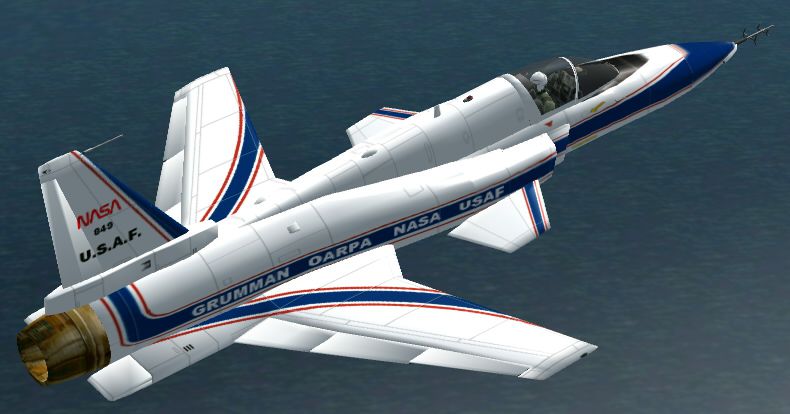
Grumman X-29 brings NASA-based forward-swept experimental flight to FSX with a faithful external model and a detailed virtual cockpit tuned to real-world specifications. The update refines compatibility and handling for modern installs, making it ideal for high-speed test sorties, unusual aerodynamics, and memorable screenshots.
Free for all simmers · 953.34 KB · Scanned clean
Download speed: Free tier is capped at 0.5 Mbps. PRO members download at full line speed.
SimObjects\Airplanes\, Addon Scenery\, Effects\, or Gauges\.readme.txt or README file. It tells you exactly where files go, what dependencies are needed, and any quirks specific to this add-on.The archive fsxx-29.zip has 39 files and directories contained within it.
This list displays the first 500 files in the package. If the package has more, you will need to download it to view them.
| Filename/Directory | File Date | File Size |
|---|---|---|
| Aircraft.cfg | 04.13.07 | 6.87 kB |
| model.NASA | 04.14.07 | 0 B |
| Model.cfg | 04.13.07 | 27 B |
| X-29NASA.mdl | 04.13.07 | 599.30 kB |
| panel | 04.14.07 | 0 B |
| back.bmp | 06.04.03 | 2.25 MB |
| f86_accel.gau | 06.06.03 | 134.00 kB |
| f86_airspeed.gau | 06.06.03 | 139.00 kB |
| f86_altimeter.gau | 06.06.03 | 157.50 kB |
| f86_compass.gau | 06.06.03 | 203.50 kB |
| f86_egt.gau | 06.06.03 | 134.00 kB |
| f86_flaps.gau | 06.08.03 | 133.00 kB |
| f86_fuelflow.gau | 06.06.03 | 134.50 kB |
| f86_fuelpress.gau | 06.07.03 | 134.00 kB |
| f86_fuelqty.gau | 06.06.03 | 135.00 kB |
| f86_gear.gau | 06.07.03 | 31.00 kB |
| f86_hydr.gau | 06.08.03 | 134.00 kB |
| f86_lights.gau | 06.08.03 | 24.00 kB |
| f86_mach.gau | 06.06.03 | 134.50 kB |
| f86_oilpress.gau | 06.06.03 | 134.00 kB |
| f86_radcomp.gau | 06.07.03 | 204.00 kB |
| f86_tach.gau | 06.06.03 | 134.50 kB |
| f86_vvi.gau | 06.06.03 | 135.00 kB |
| main.bmp | 06.08.03 | 2.25 MB |
| panel.cfg | 06.08.03 | 2.01 kB |
| sound | 04.14.07 | 0 B |
| Sound.cfg | 04.14.07 | 28 B |
| texture.NASA | 04.14.07 | 0 B |
| Fuse01.BMP | 04.13.07 | 1.00 MB |
| Fuse02.bmp | 04.13.07 | 257.05 kB |
| PILOT.bmp | 04.13.07 | 257.05 kB |
| thumbnail.JPG | 04.13.07 | 115.27 kB |
| Thumbs.db | 04.13.07 | 8.50 kB |
| Wing.bmp | 04.13.07 | 1.00 MB |
| thumbnail.JPG | 04.13.07 | 115.27 kB |
| X-29.air | 04.13.07 | 12.60 kB |
| FSXX-29 | 04.14.07 | 0 B |
| flyawaysimulation.txt | 10.29.13 | 959 B |
| Go to Fly Away Simulation.url | 01.22.16 | 52 B |
More FSX & P3D add-ons hand-picked based on this download.
FSX Other Aircraft & Vehicles
Grumman Tracker S2F Firebomber with dual monitor panel. A complete update of …
 FSX Other Aircraft & Vehicles
Grumman Tracker S2F Firebomber with dual monitor panel. A complete update of …
 FSX Other Aircraft & Vehicles
FSX Grumman HU16 Albatross. This is a model of Greg Pepper and Micheal Verlin…
 FSX Other Aircraft & Vehicles
FSX USCG Grumman Goose. A U.S. Coast Guard repaint of the default Grumman Goo…
 FSX Other Aircraft & Vehicles
A fully-featured, freeware aircraft carrier add-on for all versions of Micros…
 FSX Other Aircraft & Vehicles
Completely re-worked model and textures . New flight dynamics optimized for S…
 FSX Other Aircraft & Vehicles
FSX NASA Space Shuttle. The shuttle has been modified so that it takes off an…
 FSX Other Aircraft & Vehicles
FSX Star Wars Incom T-65 X-Wing. This model features a reasonable Mach 1.8 Vm…
Read what other simmers think, or add your own.

In response to Stuart, the quick pitch response was one of the primary benefits of the real X-29. One of the test pilots, Kurt Schroeder, did an interview on YouTube via the PeninsulaSrsVideos where he gave a particularly juicy bit of detailed data: all dynamically unstable planes, like the F-16, Saab Grippen, and X-29 have their instability measured by something known as "time to amplitude", which is a measure of how quickly they depart controlled flight due to a disturbance in AoA.
Basically it works like this: if you're flying along and your AoA deviates from nominal by 5°, the time it takes to double in amplitude, 10°, then 20°, 40°, 80°, etc. is "time to amplitude". In the X-29, this was only 0.2 seconds!! So a 5° deviation becomes 160° deviation within ONE second without corrective input. That's total structural failure in under a second, even at modest speeds, and much quicker at faster speeds.
He mentioned that, if the F-16 had "relaxed" static stability, the X-29 was "unconscious". lol It also demonstrates why computer control was absolutely mandatory on the X-29.
Although the relatively slow actuators on the canards in the test aircraft failed to take advantage of the full nimbleness capacity of the X-29 airframe, any simulation should at least match the pitch speed of the F-16 and, as Mr. Schroeder says, be capable of "out-turning any US military aircraft" released before 1990 when he flew it, including the F-16, F-18, F-15, F-14, etc. ... but perhaps not the F-22 or F-35, etc.
It should also fly conspicuously level, relative to most similar aircraft, even at very low speeds.
His interview is nearly an hour long and easy to find. I'd check it out!

The roll response is lightning fast - is the pitch response supposed to be glacially slow?

Agree with the above poster. I was very disapointed. The plane worked fine for me, however, there was no cockpit, or instrament panel, which for me makes the plane unflyable. Please fix this machine. It need more detail.