

 FSX Historic & Vintage Aircraft
Grumman Mallard G-73AT
FSX Only Grumman Mallard G-73AT v1.1 (There is also an FS9 specific version a…
Grumman’s XF5F-1 Skyrocket brings a rare 1940 twin-engine naval prototype to life with crisp DDS textures, specular shine, reflective glass, and a fully working virtual cockpit with animated controls and lights. Built as a native FSX Acceleration aircraft, it supports catapult launches and arrested landings on compatible carriers and requires the Lockheed_Vega, DeHavilland_Beaver_DHC2, and Beech_Baron gauge CAB files.
 Rate
Rate
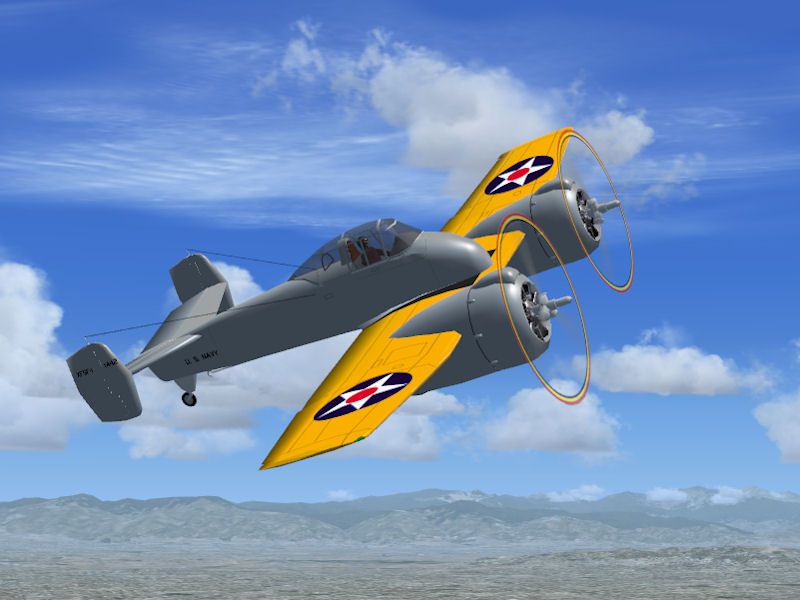
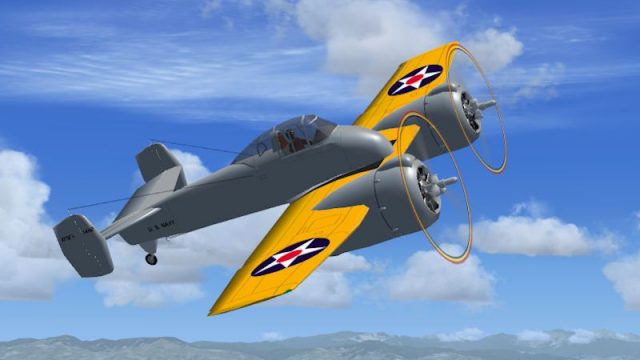
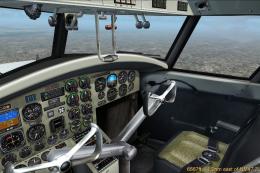
The Skyrocket first flew in 1940 and was very fast and otherwise advanced for its time. The Navy decided it wasn't interested in twin engine fighters and it was not mass produced. Grumman did use lessons learned from this prototype to later develop the very successful F7F Tigercat series. This is a native FSX Acceleration project. It has .dds textures, specular shine, reflective glass, etc. The VC has working instruments and animated flight controls. There is no 2D panel. It has the necessary entries in the aircraft.cfg file so it can catapult from and trap on an Acceleration style carrier. By Paul Clawson.
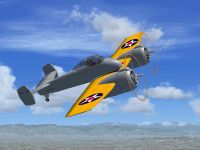
Screenshot of Grumman XF5F-1 Skyrocket in flight.
The Skyrocket was very advanced for it's day (first flew in April 1940). It was fast (438 mph in a power dive) could out climb a Spitfire and was very agile for a twin. It was easy to land and takeoff from a carrier as the engines were contra rotating thus negating any torque effects. The Navy decided it really didn't want a twin for a carrier plane at that time and opted to continue the F4F Wildcat series. The Skyrocket did provide valuable data that eventually led to the F7F Tigercat series.
This is a native FSX Acceleration project. It has .dds textures, a spectacular shine, landing and nav lights and reflective glass. The VC has working gauges and animated flight controls. There is no 2D panel. The Wright Cyclone sound file is courtesy of Obio over at the sim-outhouse forum.
I have made the necessary additions to the aircraft .cfg file so the plane can be catapulted from and can do trap landings on any Acceleration style aircraft carrier.
INSTALLATION: Unzip XF5F1vX.zip into a temporary folder. Copy the folder Grumman XF5F-1 into the Airplanes folder of FSX. Open the gauges folder and copy the file Lockheed_Vega.cab into the Gauges folder of FSX. Be sure the DeHavilland_Beaver_DHC2.cab and Beech_Baron.cab gauges have been copied from their respective panel folders into the Gauges folder of FSX if you have not already done so. That's it.
Enjoy! Paul Clawson
Free for all simmers · 8.94 MB · Scanned clean Sep 2026
Download speed: Free tier is capped at 0.5 Mbps (this file takes approximately 3 mins at the cap). PRO members download at full line speed.
SimObjects\Airplanes\, Addon Scenery\, Effects\, or Gauges\.readme.txt or README file. It tells you exactly where files go, what dependencies are needed, and any quirks specific to this add-on.The archive xf5f1vx.zip has 67 files and directories contained within it.
This list displays the first 500 files in the package. If the package has more, you will need to download it to view them.
| Filename/Directory | File Date | File Size |
|---|---|---|
| File_id.diz | 12.04.09 | 654 B |
| gauges | 12.03.09 | 0 B |
| Lockheed_Vega.cab | 06.12.03 | 415.28 kB |
| Grumman XF5F-1 | 12.03.09 | 0 B |
| Aircraft.cfg | 12.04.09 | 8.76 kB |
| model | 12.05.09 | 0 B |
| Model.cfg | 12.04.09 | 51 B |
| XF5F-1.mdl | 12.04.09 | 359.87 kB |
| XF5F-1_Interior.mdl | 12.04.09 | 281.84 kB |
| panel | 12.03.09 | 0 B |
| Panel.cfg | 12.02.09 | 2.01 kB |
| sound | 12.03.09 | 0 B |
| APW.wav | 06.02.08 | 107.88 kB |
| bomb.wav | 07.22.05 | 128.00 kB |
| Canopy Close.wav | 04.09.03 | 95.79 kB |
| Canopy Open.wav | 04.09.03 | 84.69 kB |
| canopy_slide.wav | 03.24.03 | 165.06 kB |
| flaps.wav | 06.01.08 | 63.14 kB |
| geardn.wav | 06.01.08 | 196.43 kB |
| gearup.wav | 06.01.08 | 196.43 kB |
| Read Me.TXT | 09.23.09 | 1.47 kB |
| SBD RPM1.wav | 06.02.08 | 559.11 kB |
| SBD RPM2.wav | 06.03.08 | 233.04 kB |
| SBD RPM3.wav | 06.02.08 | 617.04 kB |
| SBD RPM4.wav | 06.02.08 | 615.04 kB |
| SBD Shutdown.wav | 06.07.08 | 426.75 kB |
| SBD Starter.wav | 06.02.08 | 264.64 kB |
| SBD Startup.wav | 06.07.08 | 632.04 kB |
| sbd1c.wav | 08.24.00 | 61.70 kB |
| sbd2c.wav | 08.24.00 | 61.70 kB |
| sbdp1a.wav | 08.24.00 | 52.17 kB |
| sbdp1b.wav | 08.24.00 | 50.40 kB |
| sbdp2a.wav | 08.24.00 | 57.67 kB |
| sbdp2b.wav | 08.24.00 | 63.68 kB |
| sound.cfg | 09.23.09 | 13.80 kB |
| stallhrn.wav | 07.24.00 | 160.85 kB |
| toucc.wav | 06.01.08 | 12.26 kB |
| toucl.wav | 06.01.08 | 24.89 kB |
| toucr.wav | 06.01.08 | 9.90 kB |
| xSBD RPM1.wav | 06.02.08 | 358.70 kB |
| xSBD RPM2.wav | 06.03.08 | 233.45 kB |
| xSBD RPM3.wav | 06.03.08 | 579.04 kB |
| xSBD RPM4.wav | 06.02.08 | 495.29 kB |
| xSBD Shutdown.wav | 06.07.08 | 432.19 kB |
| xSBD Starter.wav | 06.02.08 | 264.64 kB |
| xSBD Startup.wav | 06.02.08 | 576.04 kB |
| xsbd1c.wav | 08.24.00 | 68.16 kB |
| xsbd2c.wav | 08.24.00 | 60.93 kB |
| xSBD4b.wav | 06.03.08 | 1.03 MB |
| xsbdp1a.wav | 08.24.00 | 52.17 kB |
| xsbdp1b.wav | 08.24.00 | 50.41 kB |
| xsbdp2a.wav | 08.24.00 | 57.67 kB |
| xsbdp2b.wav | 08.24.00 | 63.68 kB |
| texture | 12.03.09 | 0 B |
| prop_XF5F.dds | 11.08.09 | 64.12 kB |
| thumbnail.jpg | 12.03.09 | 16.29 kB |
| XF5F_1.dds | 12.03.09 | 1.00 MB |
| XF5F_1_T_Spec.dds | 12.03.09 | 1.00 MB |
| XF5F_2.dds | 12.03.09 | 1.00 MB |
| XF5F_2_T_Spec.dds | 12.03.09 | 1.00 MB |
| XF5F_trans.dds | 12.03.09 | 64.12 kB |
| XF5F-1.air | 11.27.09 | 7.43 kB |
| Readme.txt | 12.05.09 | 1.99 kB |
| Skyrocket.jpg | 12.03.09 | 74.96 kB |
| XF5F1vX | 12.05.09 | 0 B |
| flyawaysimulation.txt | 10.29.13 | 959 B |
| Go to Fly Away Simulation.url | 01.22.16 | 52 B |
Only PRO members can place votes.
More FSX & P3D add-ons hand-picked based on this download.
FSX Historic & Vintage Aircraft
FSX Only Grumman Mallard G-73AT v1.1 (There is also an FS9 specific version a…
 FSX Historic & Vintage Aircraft
Full package including detailed model, four liveries: Marines, US Navy, Blue …
 FSX Historic & Vintage Aircraft
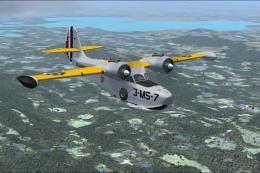
This a repaint of the default Grumman G-21 as a US Marines JRF-1A assigned to…
 FSX Historic & Vintage Aircraft
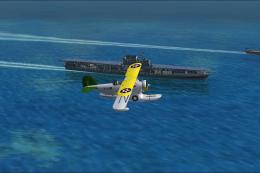
Grumman J2F Duck DXT5 textures. FSX optimized DXT5 format extended bitmap for…
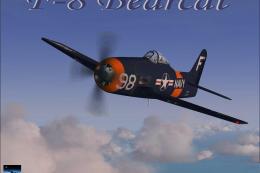 FSX Historic & Vintage Aircraft
A repaint of Michel Migaud's GrummanF8F2 Bearcat. This repaint is Grumman F8F…
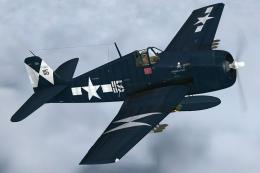 FSX Historic & Vintage Aircraft
A repaint of the RealFlight Simulations F6F Hellcat. These textures represent…
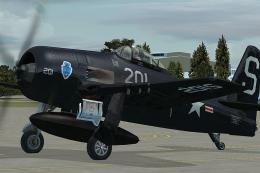 FSX Historic & Vintage Aircraft
This repaint of the Vertigo Studios Grumman F8F "Bearcat" represent a Bearcat…
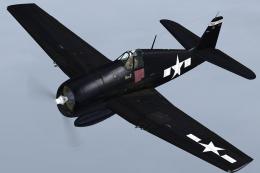 FSX Historic & Vintage Aircraft
US Navy Grumman F6F Hellcat "Minsi III", flown by MOH winner Cdr David McCamp…
Read what other simmers think, or add your own.

I like the XP-50 version with cannons and turbo for the Army. No Allied production fighter could match the XF5F in 1941, even though it had twin engines with the most drag. Even without the immature turbo. The XP-50 turbo and the strengthened tail assembly gave improved handling and performance. It was a world-beater that early. Not one but two HS 20mm cannons and HMGs all in the nose!! What US fighter had a harder hitting salvo with harmonized ballistics pre-war. 2 or 4x23mm cannons were originally considered! Wow!
383 mph level max speed and 438 in a dive for the F5F and the P-50 was estimated at 424 with turbo. Climb was the best part. 3800-5000'/m! And it could fly on one engine. What did Grumman need it to do? Neither the Navy or the Army wanted it produced until the jet age F7F twin prop. Go figure!