Page 26
Searches the whole library — filter by sim & category on the results page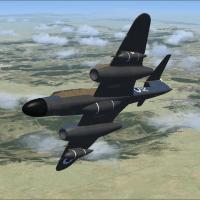 Repaint
Rob Richardson’s freeware Armstrong-Whitworth Meteor NF11 model informs the basis of this Israeli Air Force night-fighter, which carries aircraft number 52. It features an AI Mk 10 radar in the ext…
 9.74 MB
 48Jan 2016
 4
4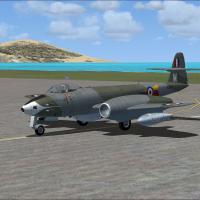 Repaint
VZ603, by Peter Watkins, denotes the Gloster Meteor FR Mk 9 used by No 8 Squadron RAF at RAF Khormaksar, Aden, in June 1958, and carries the ATC ID VZ603 with a designation reflecting its historica…
14.31 MB47Jan 20164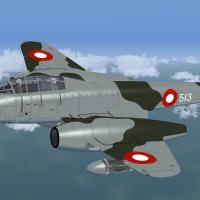 Repaint
The NF11 variant bears the designation 51-513 from 723 ESK of the Royal Danish Air Force, serving at Aalborg AB in 1953. Jens-Ole Kjolber refines panel lines and details, while the fltsim entry lis…
1.04 MB46Jan 20162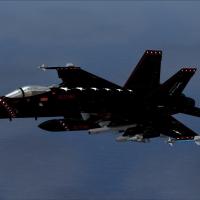 Payware Repaint
VX-9's Salty Dogs appear as the VX9-333 variant modeled by Vertical Reality Simulations, with BuNo 166957 assigned to the squadron based at NAS China Lake, California. The configuration lists calls…
4.22 MB40Jan 20161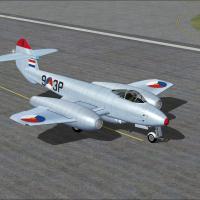 Repaint
Centered on the ex-RAF VT333, the I-76 ATC ID designation represents a No 324 Squadron Dutch air force airframe based at Leeuwarden in service. The airframe withdraws from use in May 1957, and Pete…
12.98 MB38Jan 20165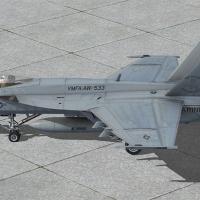 Payware Repaint
Nathan Havercroft provides this freeware coloration for the VRS F/A-18E Super Hornet, capturing VMFA(AW)-533 Hawks during the 2011 WESTPAC deployment and adapting the dual-seat D heritage to the si…
5.75 MB30Jan 20163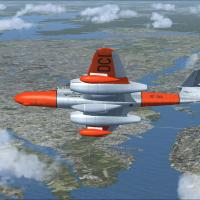 Repaint
By Rob Richardson and Peter Watkins, this NF11 SE-DCI representation documents a twin-jet night fighter originally delivered to the Royal Danish Air Force as H-519 in March 1953, later one of six M…
10.25 MB28Jan 20164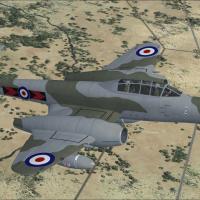 Repaint
The Armstrong-Whitworth Meteor NF11 WM321 serves as a twin-engine night fighter used by the RAF in the early 1950s, with WM321 originally NF13 from February 1953 and closely mirroring NF11. It oper…
9.66 MB25Jan 20164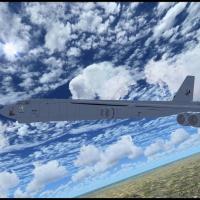 Base Model
Two US Air Force B-52H models, registrations 60-042 and 60-047, base at Barksdale AFB and share identical flight dynamics by Mike Stone; 60-047 textures by Bill Baldwin and corrections by Douglas E…
37.84 MB28.1KFeb 2009 3/511
3/511 Video
Video Base Model
By Kirk Olsson, the model presents a fighter jet depicted in flight, with an emphasis on a dynamic in-air pose. The accompanying screenshot confirms an in-flight view, anchoring the presentation to…
25.95 MB16KJan 20135/5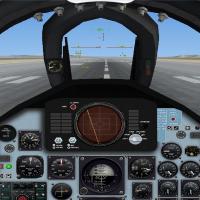 Base Model
Two model variants of the F-4 Phantom II appear here, featuring 13 surface finishes and new thumbnails by Michael Pook, compiled by David Robles with Iris Simulations' permission. The radar screen …
102.51 MB15.4KFeb 20164/531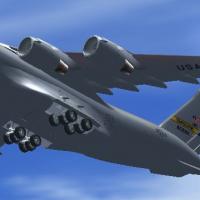 Base Model
The United States Air Force heavy airlifter with serial 88-0266, assigned to Charleston AFB, receives a thorough overhaul of the .cfg and .air files and features hand-painted surface work on the Pi…
1.1 MB11.2KJan 20093/51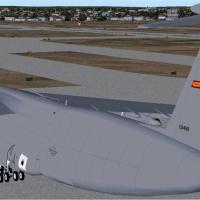 Base Model
USAF operates the C-5B Galaxy from Altus AFB, home to the 97th AETC/OG. The variant targets long-distance, high-altitude missions and has cargo and crew access doors, with flight dynamics tuned for…
56.95 MB10.4KNov 20094/51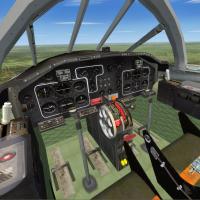 Base Model
A freeware jet trainer emphasizes side-by-side seating and a fully functional cockpit. Only 20 units are produced, and an AI traffic package places the type at Twente and Soesterberg, with NL2000-c…
758.2 MB10.3KFeb 20165/546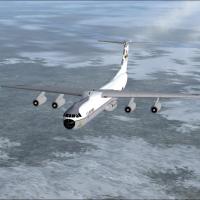 Base Model
An enhanced Lockheed C-141 Starlifter rendition builds on real-world flight dynamics and engine specifications. Douglas E. Trapp provides flight dynamics, the model flies over 7000 nautical miles a…
51.52 MB10.1KJan 20104/51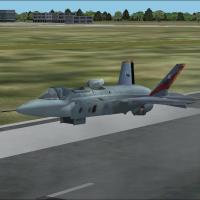 Base Model
Colin Thwaites provides the original version of a Lockheed F-35 model, a concise reference that preserves its provenance, while an image at /downloadimages/Image/f-35_lig.gif accompanies the piece,…
47.85 MB9.4KFeb 20092/52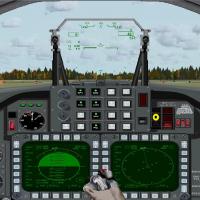 Base Model
Derives from the David Brice and David Friswell T45 Goshawk / T1 Hawk models, this depiction captures the Red Arrows display sequence. The formation begins in 1965 at RAF Fairford, grows from seven…
24.1 MB9.3KNov 20074/533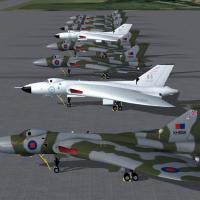 Base Model
Twenty-six aircraft populate the lineup, featuring 7-LOD models with eight variations. XH558, the only flying Vulcan, appears, while John Young, ACG, receives credit, and Military Sound Studios sup…
80.29 MB9.3KJun 20155/53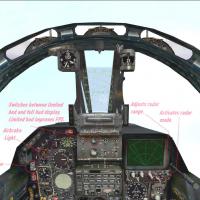 Base Model
Four Mirage F1 variants—F1C, F1AZ, F1CR, and F1CT—include CR-model VR cockpits and a revised panel. The lineup adds six loadout configurations and six paint schemes, plus an all-new virtual cockpit…
87.85 MB9KNov 20094/511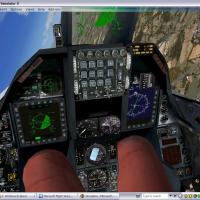 Base Model
An F-16 Fighting Falcon conversion, by Kirk Olsson and updated by Danny Garnier, includes gauges compatible with the virtual cockpit and a fully edited 2D panel, with gauges and BMPs included thoug…
19.88 MB8.5KSep 20115/55