Page 22
Searches the whole library — filter by sim & category on the results page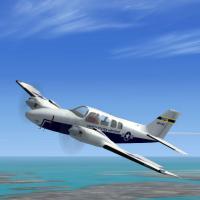 Base Model
By Mark Rooks, this US Air Force Beechcraft T-42 variant integrates the Beech Baron airframe with US markings for instrument training and executive travel. The offering comprises six essential item…
 2.18 MB
 226Sep 2011
 1
1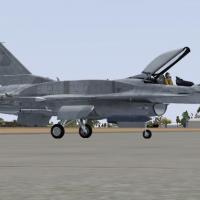 Payware Repaint
UAE Air Force F-16E Block 60 Desert Falcon appears with markings removed, representing several aircraft engaged in anti-IS operations. The variant uses a UI designation of F-16E Block 60 with varia…
4.95 MB220Jan 20161
Variant Golddust presents a fictional F/A-18 Hornet configuration and carries Navy ATC data with atc_id N001 and atc_flight_number 001. The UI lists Boeing as manufacturer, type F/A-18, and variati…
1.62 MB220Sep 2011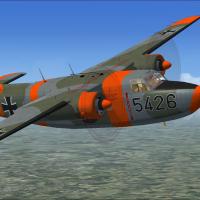 Repaint
5426 c/n P66/1018 is one of 25 aircraft delivered to the West German Luftwaffe, and the fuselage remains at Luftwaffen Museum at Berlin-Gatow with code 5426. Ex GB-361 and XA-106 are noted, and the…
12.5 MB216Feb 20161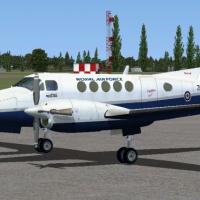 Repaint
ISDT offers a single-variant release that carries the ZK450 code, styled in 45 Squadron colors for RAF operations, with skin work provided by UKMIL. The model uses ISDT_B200LW as its base designati…
1.41 MB214Jul 20153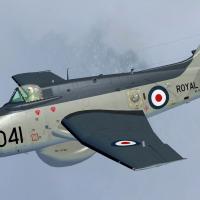 Repaint
Assigned to B flight 849 NAS, the XL502 '041' designation marks an aircraft that flies from HMS Ark Royal in 1970, by Robert Richardson. The 041 designation anchors this variant to 849 NAS, alignin…
6.88 MB214Jun 20153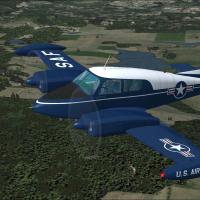 Repaint
Rob Richardson's Cessna 310B carries a USAF connection, with serial 58-2124 among 160 Cessna 310A aircraft ordered for general communications role and later redesignated from L-27A to U-3A. Unoffic…
7.48 MB208Jan 20164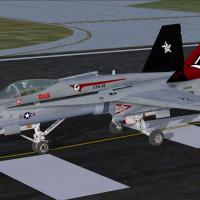 Repaint
VFA-14 insignia decorate the F/A-18C Hornet, featuring a distinctive top hat motif across the stabilizers, nose, and fuselage with a CAG emblem. By Ray Gagnon, the Navy-focused variant requires the…
2.94 MB207Sep 20113 Patch
PatchBy Frank Safranek, this correction accompanies the Brasilian Air Force Rafale FX-2 configuration and fixes the spelling of Forca Aerea Brasileira on one marking, ensuring proper display. It relies …
238.32 KB205Oct 2012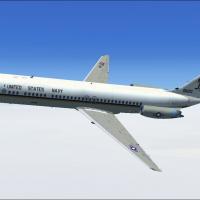 Payware Repaint
United States Navy C-9B variant based on the DC-9 operates with VR-56 and bases at NAS Oceana, Virginia, with squadron markings faithfully reproducing authentic operations, by John Detrick. Sky Sim…
3.19 MB203Sep 20114 Repaint
Ray Gagnon crafts a MARPAT digital camouflage pattern for the F/A-18C that captures VMFA-314, the Black Knights, and bases it on the Boeing Hornet lineage. A folder named blackknightsmarpat houses …
3.91 MB199Sep 20111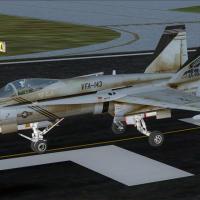 Repaint
Ray Gagnon presents FA-18 Pukin Dogs Low Vis Weathered, a variant for the default F/A-18C Hornet reflecting VFA-143 markings. Created by Ray Gagnon, it uses atc_id 101, atc_airline Navy, and atc_fl…
3.25 MB198Sep 20113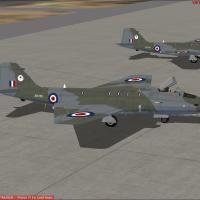 Repaint
By Dale Ashcroft, these Canberra PR9 variants use John Young's model and his paint kit to reproduce Royal Air Force machines assigned to 13 Squadron, based at Akrotiri and Malta. Aircraft are based…
2.62 MB195Oct 20121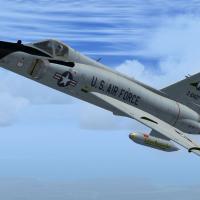 Payware Repaint
Three variants cover Vermont Air National Guard Convair F-102A Delta Dagger entries for the 134th Fighter Interceptor Squadron, VT ANG, based at Burlington during 1968–74. Airframes 56-1427, 57-087…
20.2 MB193Jul 20154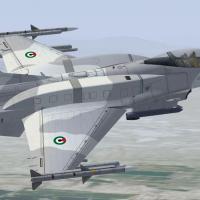 Payware Repaint
Folder UAE_Dirty presents a weathered UAE Air Force F-16E Block 60 Desert Falcon, a single-engine fighter with Conformal Fuel Tanks and an upgraded cockpit radar, created by S. Peterson for a paywa…
5.01 MB191Jan 20162
G-APUX identifies the Hawker Hunter demonstrator in a two-seat variant dating to circa 1963 today. For Dave Garwood's two-seat Hawker Hunter lineage, John Detrick provides color detailing, and FSX …
2.08 MB187Sep 20115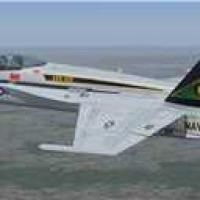 Repaint
An enhanced skin for the F/A-18C Hornet captures US Navy VFA-105’s Gunslingers CAG markings, including precise vertical stabilizer art and fuselage numerals reflecting carrier operations. It requir…
4.78 MB187Sep 20111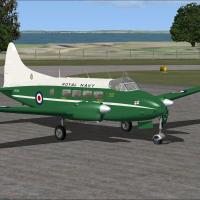 Payware Repaint
Variant XK895 for the DH104 Dove marks Royal Navy service beginning in 1956 and transitions to civilian use as G-SDEV in 1990; the aircraft currently registers to Aviation Heritage Ltd in Coventry.…
19.66 MB185Feb 20164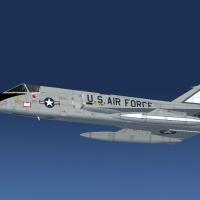 Repaint
Capt. Bill McNelis flies 59-1045 from the 48th FIS at Langley AFB in the early 1980s. A revised three-bump tail detail accompanies the offering, while wing visuals can be copied to the 101st folder…
1.9 MB184Jun 20153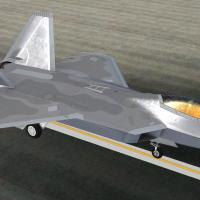 Payware Repaint
Authored by S. Peterson, this 422nd TES heritage decorates the F-22 Raptor with the OT-068 tail code and unit emblems. It relies on the Raptor Driver payware model, and the Eglin folder houses DDS …
9.28 MB183Jan 20164